20 Types of Outsourcing Every Business Should Know
Work piling up faster than your inbox messages? Explore 20 types of outsourcing to help your business stay productive without the chaos.

Trying to handle every task in-house? That's a fast way to exhaust your team and slow your business down. The solution is choosing the right type of outsourcing. Depending on your business needs, you can outsource by location, business function, or engagement model.
To help you choose the right type, we've compiled the 20 most common types of outsourcing, their benefits, ideal use cases, and how to choose the one that aligns with your business goals.
What Is Outsourcing?
Outsourcing is the practice of hiring an external company, agency, or independent professional to handle specific tasks, services, or business processes instead of managing them with your in-house team. It helps you reduce operating costs, access specialized expertise, improve efficiency, and free up your employees to focus on your core business activities.
Whether you need support with IT, customer service, HR, accounting, or marketing, outsourcing gives you the flexibility to scale your business without increasing your internal workforce.

Did you Know?
80% of executives plan to maintain or increase their investment in third-party outsourcing, showing that outsourcing remains a long-term business strategy rather than a short-term cost-cutting measure.
Why Understanding Different Types of Outsourcing Matters
Choosing the right type of outsourcing can make a significant difference in how efficiently your business operates. Here's why it matters:
- Helps You Choose the Right Strategy: Different outsourcing models serve different purposes. Understanding them helps you select the best option for your business goals.
- Reduces Costs Without Compromising Quality: The right outsourcing approach lets you optimize expenses while maintaining high-quality results.
- Gives You Access to Specialized Expertise: You can bring in professionals with the exact skills you need instead of hiring full-time employees.
- Improves Productivity: Outsourcing routine or specialized tasks allows your internal team to focus on high-value work that drives business growth.
- Supports Business Growth: As your business expands, outsourcing makes it easier to scale operations without significantly increasing overhead.
- Minimizes Risks: Understanding the differences between outsourcing types helps you avoid issues related to communication, compliance, security, and project management.
- Enables Better Decision-Making: Knowing your options allows you to compare costs, flexibility, and control before choosing the outsourcing model that best fits your needs.
Looking for a smarter way to manage outsourced teams?
Types of Outsourcing by Location
One of the most common ways to classify outsourcing is based on where the service provider is located. Depending on your budget, communication preferences, and business requirements, you can choose to outsource within your own country or work with teams across the globe. The four main types of outsourcing by location are onshore, nearshore, offshore, and multi-shore outsourcing.
1. Onshore Outsourcing
Onshore outsourcing, also known as domestic outsourcing, means hiring a service provider within your own country. Since both your business and your outsourcing partner share the same language, culture, regulations, and time zone, communication and collaboration are usually much smoother. For a detailed comparison, see our guide on offshore vs onshore outsourcing.
Best for:
- Highly regulated industries
- Customer-facing roles
- Businesses that require frequent collaboration
Example: A company in New York hires a software development firm based in California.
2. Nearshore Outsourcing
Nearshore outsourcing involves working with a provider in a neighboring or nearby country. This option offers lower labor costs while maintaining similar time zones and cultural compatibility, making collaboration more convenient.
Best for:
- Software development
- Customer support
- Businesses requiring regular communication
Example: A US company partners with a development team in Mexico.
3. Offshore Outsourcing
Offshore outsourcing means hiring a company in a distant country, often with significantly lower labor costs. Many businesses choose offshore outsourcing to access a larger talent pool, reduce operating expenses, and provide around-the-clock support.
Best for:
- IT services
- Customer support
- Data entry
- Accounting
- Large-scale business processes
Example: A UK business outsources customer support to the Philippines or software development to India.
4. Multi-Shore (Hybrid) Outsourcing
Multi-shore, or hybrid outsourcing, combines two or more outsourcing locations to maximize the benefits of each. For example, you might keep strategic work onshore, collaborate with a nearshore team for development, and outsource customer support offshore.
This approach helps you balance cost savings, productivity, risk management, and business continuity.
Best for:
- Large organizations
- Global businesses
- Companies managing multiple functions
Example: A company handles product management in the US, software development in Colombia, and customer support in India.
Comparison Table
| Type | Location | Cost | |
|---|---|---|---|
| Onshore Outsourcing | Same country | High | Regulated industries, customer-facing roles, and businesses that require close collaboration |
| Nearshore Outsourcing | Neighboring or nearby country | Medium | Software development, customer support, and projects requiring real-time collaboration |
| Offshore Outsourcing | Distant country | Low | Cost-sensitive operations, specialized talent, and 24/7 business support |
| Multi-Shore (Hybrid) Outsourcing | Multiple countries | Varies | Large organizations managing diverse functions across different regions |
Types of Outsourcing by Business Function
Another way to classify outsourcing is by the type of work you need to delegate. Whether you want to outsource IT, HR, customer support, or manufacturing, each outsourcing model is designed to handle a specific business function. Understanding these categories helps you choose the right service provider based on your operational needs.
5. Business Process Outsourcing (BPO)
Business Process Outsourcing (BPO) involves outsourcing routine business operations to a third-party provider. These tasks are usually repetitive, process-driven, and essential for daily operations. Instead of handling these functions internally, you can rely on experienced service providers to manage them more efficiently.
Common services include:
- Customer support
- Data entry
- Payroll processing
- HR administration
- Accounting
Best for: Businesses looking to reduce operational costs and improve efficiency.
6. Information Technology Outsourcing (ITO)
Information Technology Outsourcing (ITO) involves hiring external experts to manage your technology-related operations. Instead of building a large in-house IT team, you can outsource technical tasks to experienced professionals. This gives you access to specialized skills, the latest technologies, and faster project delivery. It also allows your internal team to focus on innovation rather than routine IT maintenance.
Common services include:
- Software development
- IT support
- Cloud management
- Cybersecurity
- Infrastructure management
Best for: Businesses that need specialized IT expertise or want to scale their technology capabilities. Explore the best software development tools your ITO partners typically use to deliver these services.
7. Knowledge Process Outsourcing (KPO)
Knowledge Process Outsourcing (KPO) focuses on outsourcing work that requires specialized knowledge, analytical skills, and industry expertise. These services often involve research, strategic thinking, and data interpretation. KPO providers help you make informed business decisions by delivering valuable insights and expert analysis. This model is ideal when accuracy, expertise, and innovation are more important than simply reducing costs.
Common services include:
- Market research
- Financial analysis
- Data analytics
- Business research
- Intellectual property research
Best for: Organizations requiring expert insights and data-driven decision-making.
8. Legal Process Outsourcing (LPO)
Legal Process Outsourcing (LPO) involves outsourcing legal services to specialized firms or legal professionals. It helps you reduce legal expenses while maintaining access to qualified legal expertise. You can delegate time-consuming legal tasks without expanding your in-house legal team. This improves efficiency while ensuring compliance with legal and regulatory requirements.
Common services include:
- Contract drafting
- Legal research
- Document review
- Compliance support
- Intellectual property services
Best for: Law firms and businesses handling large volumes of legal work.
9. Recruitment Process Outsourcing (RPO)
Recruitment Process Outsourcing (RPO) means outsourcing all or part of your hiring process to a specialized recruitment provider. They manage everything from sourcing candidates to onboarding new employees. This approach helps you shorten hiring cycles, improve candidate quality, and create a more consistent recruitment process. It is especially useful when your business experiences rapid growth or seasonal hiring demands.
Common services include:
- Candidate sourcing
- Resume screening
- Interview scheduling
- Recruitment marketing
- Onboarding support
Best for: Businesses with ongoing or high-volume hiring needs.
10. Human Resource Outsourcing (HRO)
Human Resource Outsourcing (HRO) involves delegating HR functions to external providers so you can focus on growing your business while ensuring your workforce is managed effectively. These providers handle day-to-day HR responsibilities while helping you stay compliant with labor laws and employment regulations. This allows you to improve employee experiences without increasing administrative work.
Common services include:
- Payroll management
- Employee benefits administration
- Compliance management
- Training and development
- Performance management
Best for: Small and growing businesses that need professional HR support without building a full HR department.
11. Customer Service Outsourcing
Customer service outsourcing allows you to delegate customer interactions to external support teams. This helps you provide consistent service while reducing the workload on your internal staff. Many outsourcing providers offer multilingual support and 24/7 availability, allowing you to serve customers across different regions and time zones. This can improve customer satisfaction without significantly increasing operational costs.
Common services include:
- Phone support
- Live chat support
- Email support
- Technical support
- Social media customer service
Best for: Businesses that need 24/7 customer support or handle large volumes of customer inquiries.
12. Finance & Accounting Outsourcing
Finance and accounting outsourcing involves hiring external professionals to manage financial operations accurately and efficiently. This helps improve compliance while reducing administrative costs. Experienced financial specialists can handle complex accounting tasks while ensuring your records remain accurate and up to date. This reduces the risk of errors and allows you to focus on project costs.
Common services include:
- Bookkeeping
- Tax preparation
- Accounts payable and receivable
- Financial reporting
- Payroll accounting
Best for: Businesses looking to improve financial accuracy while reducing operational expenses.
13. Manufacturing Outsourcing
Manufacturing outsourcing involves partnering with third-party manufacturers to produce your products instead of operating your own production facility. This allows you to reduce capital investment and scale production more efficiently. You can also benefit from established manufacturing expertise, modern production facilities, and simplified supply chains. This makes it easier to meet changing customer demand without investing heavily in infrastructure.
Common services include:
- Product manufacturing
- Assembly
- Packaging
- Quality testing
- Supply chain support
Best for: Companies that want to lower production costs, increase manufacturing capacity, and focus on product innovation.
Comparison Table:
| Common Services | Best For | |
|---|---|---|
| BPO | Customer support, payroll, HR administration, accounting | Routine business operations |
| ITO | Software development, IT support, cloud services, cybersecurity | Technology management |
| KPO | Research, financial analysis, business intelligence | Specialized knowledge work |
| LPO | Legal research, contract drafting, document review | Legal services |
| RPO | Hiring, sourcing, screening, onboarding | Recruitment and talent acquisition |
| HRO | Payroll, benefits, compliance, employee management | Human resource management |
| Customer Service Outsourcing | Phone, email, chat, technical support | Customer support operations |
| Finance & Accounting Outsourcing | Bookkeeping, tax, payroll, reporting | Financial management |
| Manufacturing Outsourcing | Production, assembly, packaging, quality control | Product manufacturing |
Ready to outsource your business functions more effectively?
Manage your outsourced IT, HR, finance, and customer support teams with Time Champ.
Types of Outsourcing by Engagement Model
Besides location and business function, outsourcing can also be classified by how you work with an external provider. The engagement model defines the structure of your partnership, including the level of control, flexibility, and responsibility shared between you and the service provider.
14. Project-Based Outsourcing
Project-based outsourcing involves hiring an external provider to complete a specific project within an agreed scope, budget, and timeline. Once the project is finished, the engagement typically ends. This model works well when you have clearly defined requirements and don't need ongoing support. It allows you to access specialized expertise without committing to a long-term partnership.
Common use cases include:
- Website development
- Mobile app development
- Software implementation
- Marketing campaigns
- Product design
Best for: Businesses with short-term projects and clearly defined deliverables.
15. Staff Augmentation
Staff augmentation allows you to temporarily add skilled professionals to your existing team. Instead of outsourcing an entire project, you bring in external talent to fill specific skill gaps while maintaining full control over the work. This model offers flexibility, making it easier to scale your workforce up or down as project demands change. It also helps you access specialized expertise without hiring permanent employees.
Common use cases include:
- Software development
- IT consulting
- Engineering projects
- Design services
- Quality assurance
Best for: Businesses that need additional expertise or temporary resources for ongoing projects.
16. Build-Operate-Transfer (BOT)
Build-Operate-Transfer (BOT) is an outsourcing model where a service provider builds and manages a team or operational center on your behalf before eventually transferring ownership to your business. This approach allows you to establish operations quickly while reducing the risks associated with setting up a new location or business function. Once the operation becomes stable, you take full control of the team and its processes.
Common use cases include:
- Global capability centers
- Software development centers
- Shared service centers
- Manufacturing facilities
- Offshore operations
Best for: Businesses planning long-term expansion while minimizing setup risks.
Comparison Table:
| Model | How It Works | Best For |
|---|---|---|
| Project-Based Outsourcing | A provider completes a specific project within a fixed scope, budget, and timeline. | Short-term projects with well-defined deliverables |
| Staff Augmentation | External professionals join your existing team to fill temporary skill or resource gaps. | Ongoing projects that require additional expertise |
| Build-Operate-Transfer (BOT) | A provider builds and manages an operation before transferring it to your business. | Long-term business expansion and establishing new operational centers |
Emerging Types of Outsourcing in 2026
As technology and workforce trends continue to evolve, businesses are adopting newer outsourcing models that offer greater flexibility, global reach, and access to advanced capabilities. These emerging types of outsourcing help you adapt to changing business needs while remaining competitive in a rapidly evolving market.
17. AI-Augmented Outsourcing
AI-augmented outsourcing combines human expertise with artificial intelligence to improve speed, accuracy, and efficiency. Instead of relying solely on manual processes, outsourcing providers use AI tools to automate repetitive tasks and support data-driven decision-making. This approach helps you reduce turnaround times, improve service quality, and lower operational costs while allowing human experts to focus on more complex work.
Common use cases include:
- Customer support chatbots
- Content creation
- Data analysis
- Document processing
- Software development assistance
Best for: Businesses looking to improve productivity through AI-powered automation.
18. Employer of Record (EOR)
An Employer of Record (EOR) enables you to hire employees in countries where you don't have a legal business entity. The EOR becomes the official employer and manages payroll, taxes, benefits, and legal compliance, while your business oversees the employee's day-to-day work. This model makes global hiring faster and reduces the complexity of international employment regulations. It also allows you to expand into new markets without setting up a local office.
Common use cases include:
- International hiring
- Remote workforce expansion
- Global talent acquisition
- Market expansion
Best for: Businesses planning to hire employees across multiple countries.
19. Global Capability Centers (GCC/GIC)
Global Capability Centers (GCCs), also known as Global In-house Centers (GICs), are dedicated facilities established in another country to manage key business functions. Unlike traditional outsourcing, these centers operate as an extension of your organization while providing access to skilled talent and lower operating costs. They help you retain greater control over operations while benefiting from global talent and regional cost advantages. Many large enterprises use GCCs to support innovation, technology, finance, and customer operations.
Common use cases include:
- Software development
- Finance and accounting
- Customer support
- Research and development
- Shared business services
Best for: Large organizations with long-term global expansion strategies.
20. Gig Economy Outsourcing
Gig economy outsourcing involves hiring independent freelancers or contractors for short-term assignments instead of employing full-time staff. This model gives you the flexibility to quickly access specialized skills whenever needed without making long-term hiring commitments. It is particularly useful for project-based work, seasonal demand, or niche expertise. Popular freelance platforms have made it easier than ever to connect with skilled professionals worldwide.
Common use cases include:
- Graphic design
- Content writing
- Web development
- Video editing
- Digital marketing
Best for: Businesses seeking flexible, on-demand talent for short-term projects.
Comparison Table:
| Type | How It Works | Best For |
|---|---|---|
| AI-Augmented Outsourcing | Combines AI tools with human expertise to automate and improve business processes. | Businesses adopting AI-driven productivity and automation |
| Employer of Record (EOR) | A third party legally employs international workers while you manage their daily work. | Global hiring and remote workforce expansion |
| Global Capability Centers (GCC/GIC) | Your company establishes a dedicated overseas center to manage core business functions. | Large organizations expanding global operations |
| Gig Economy Outsourcing | Independent freelancers or contractors complete work on a project or contract basis. | Short-term projects and specialized skill requirements |
Which Type of Outsourcing Is Right for Your Business?
Choosing the right type of outsourcing depends on your business goals, budget, and operational requirements. Asking the right questions before outsourcing can help you find a model that delivers the best results.
1. Identify the Work You Want to Outsource
Start by determining which tasks or processes you want to delegate. Routine functions like customer support or payroll may require a different outsourcing model than specialized services such as software development or legal consulting.
2. Define Your Business Goals
Consider what you want to achieve through outsourcing. Whether your priority is reducing costs, accessing specialized expertise, improving efficiency, or scaling operations, your goals will help you choose the most suitable outsourcing type.
3. Choose the Right Location
Decide whether you want to work with a provider in your own country, a neighboring country, or overseas. Your decision should balance cost, regulatory requirements, time zone compatibility, and collaboration needs.
4. Select the Right Engagement Model
Think about how you want to work with your outsourcing partner. If you need help with a one-time project, project-based outsourcing may be ideal. If you need additional expertise within your existing team, staff augmentation is often a better choice.
5. Evaluate Cost and Value
Don't focus only on the lowest price. Compare the overall value each outsourcing model offers, including quality, reliability, scalability, and long-term business benefits.
6. Consider Future Growth
Choose an outsourcing partner that can grow with your business. A scalable provider will make it easier to expand services, enter new markets, or handle increased workloads without disrupting your operations.
How Time Champ Helps You Manage Outsourced Teams
Managing outsourced teams can be challenging when employees work across different locations, time zones, and organizations. Without clear visibility, it becomes difficult to measure productivity, track progress, and ensure accountability. Time Champ is an employee monitoring software that gives you the insights you need to manage outsourced teams more effectively from a single platform.
Whether you manage onshore, offshore, or hybrid outsourced teams, Time Champ gives you complete visibility into how work gets done, helping you improve accountability, optimize performance, and make data-driven decisions.
Key Features of Time Champ:
Automated Time Tracking
Track work hours and time spent on projects automatically, eliminating manual timesheets. This helps you verify billable hours, improve transparency, and manage outsourced teams more accurately.
Productivity Monitoring
Get real-time insights into how outsourced teams spend their workday. Identify productivity trends, measure performance, and ensure employees stay focused on their work.
Project and Task Tracking
Track project progress, task completion, and resource utilization in real time. This helps you identify delays early and keep outsourced projects on schedule.
Activity Monitoring
Monitor application usage, website activity, and work sessions to gain better visibility into daily operations. Capture automatic screenshots, review screen recordings, and use live screen monitoring to understand work progress and support outsourced teams without disrupting their workflow.
Workforce Analytics and Reports
Access detailed reports on productivity, attendance, and project performance. These insights help you evaluate outsourced teams and make informed management decisions.
Data Loss Prevention
Protect sensitive business data with features like USB access control, file monitoring, and real-time security alerts. This helps reduce data security risks when working with external teams.
Ready to take control of your outsourced teams?
Choosing the right type of outsourcing starts with understanding your business needs. Whether you're outsourcing by location, business function, or engagement model, the right approach can help you reduce costs, access skilled talent, and work more efficiently.
Once your outsourced team is in place, managing it effectively is just as important. Time Champ gives you the visibility to track time, monitor productivity, manage projects, and keep your outsourced workforce aligned with your business goals.
Guna Lakshmi

Table of Content
 What Is Outsourcing?
- Why Understanding Different Types of Outsourcing Matters
- Types of Outsourcing by Location
- Types of Outsourcing by Business Function
- Types of Outsourcing by Engagement Model
- Emerging Types of Outsourcing in 2026
- Which Type of Outsourcing Is Right for Your Business?
- How Time Champ Helps You Manage Outsourced Teams

Related Blogs
Discover the essence of outsourcing and explore the top global outsourcing companies. Elevate your business efficiency with strategic partnerships and expert solutions
Mounika Sai | Nov 16, 2023
Discover the 12 benefits of outsourcing, including cost savings, access to global talent, and practical tips for managing outsourced teams effectively.
Guna Lakshmi | Jul 10, 2026
https://www.timechamp.io/blogs/benefits-of-outsourcing
Vijaya Lakshmi | 12 Benefits of Outsourcing (with Data and Examples)Business process outsourcing (BPO) vs Knowledge process outsourcing (KPO). Discover definitions of BPO and KPO, key functions, similarities, and use cases.
Jul 10, 2026 | Apr 02, 2026Uncover the future of outsourcing services: Dive into how businesses are transforming efficiency and growth with advanced technology.
Jahnavi Pulluri | May 17, 2024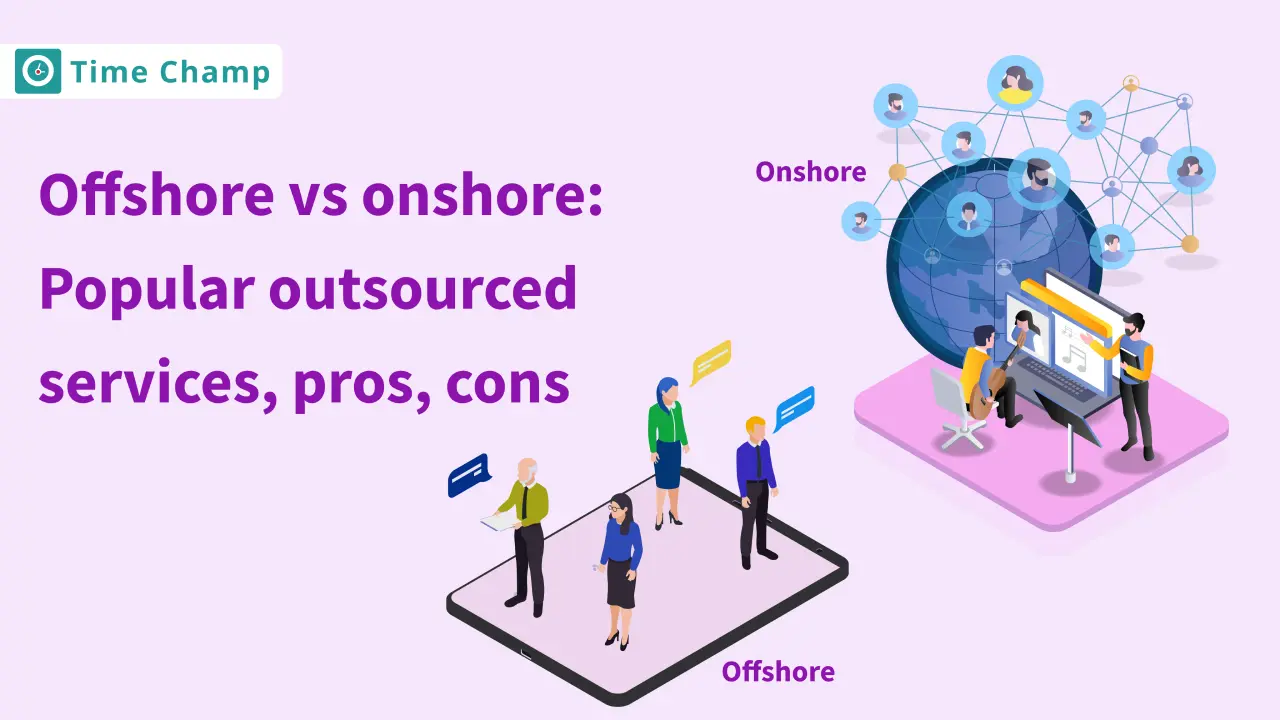
Exploring offshore and onshore outsourcing: Compare popular services, advantages, and drawbacks to make informed business decisions.
Mounika Sai | Nov 20, 2023


 4.7/5 avg.
Ready to Manage Your Workforce Smarter?
Join our family of 1100+ companies using smart insights to redefine workforces!

Free Trial
No Credit Card Required